
For many sponsors, the Investigational New Drug (IND) application is viewed as a procedural milestone, the point at which a development program transitions from preclinical research into human studies.
But in today’s regulatory environment, IND readiness is not simply about assembling documentation. It is about demonstrating that your program is strategically aligned, scientifically justified, and operationally executable.
Sponsors who treat the IND as a checklist exercise often encounter avoidable challenges, including:
- FDA information requests that slow review timelines
- Clinical holds driven by gaps in safety or study design
- Misalignment between early development strategy and long-term regulatory expectations
In contrast, sponsors who approach IND readiness as a cross-functional risk management exercise are far better positioned for efficient review and successful clinical execution.
Where Do IND Submissions Commonly Go Wrong?
Even well-resourced organizations encounter issues during IND preparation. These challenges rarely stem from a single deficiency. Instead, they arise from gaps across multiple disciplines that only become visible during FDA review.
1. Regulatory Strategy Is Underdeveloped
A common misconception is that regulatory strategy can evolve after the IND is submitted. In reality, FDA reviewers expect to see a clear and credible development path from the outset.
Without a defined strategy:
- Clinical trial design may not align with regulatory expectations
- Opportunities for expedited pathways may be missed
- Early FDA feedback may be limited or non-actionable
2. Nonclinical Data Does Not Fully Support Clinical Plan
FDA’s primary concern during IND review is patient safety. If the nonclinical package does not adequately support the proposed clinical study, the risk of delay increases significantly.
Common issues include:
- Insufficient toxicology data to support dosing duration
- Weak or unclear starting dose justification
- Lack of alignment between nonclinical findings and clinical design
3. CMC Readiness Is Treated as Secondary
In early development, sponsors sometimes underestimate the importance of Chemistry, Manufacturing, and Controls (CMC) readiness.
However, FDA expects:
- A clearly defined manufacturing process
- Appropriate controls and specifications
- Evidence of product consistency
Incomplete CMC information is one of the most frequent drivers of IND review questions and delays.
4. Clinical Protocols Are Not Fully Aligned with Risk and Objectives
First-in-human studies must balance safety with the need to generate meaningful data.
Protocols that raise concerns often:
- Lack sufficient safety monitoring or stopping rules
- Propose aggressive dose escalation without adequate justification
- Fail to generate data that supports future development decisions
5. Submission Quality Slows FDA Review
Even when the science is sound, poorly structured INDs can create friction during review.
Common issues include:
- Inconsistent or unclear summaries
- Weak cross-referencing across modules
- Lack of a cohesive narrative explaining the program
An IND submission should make it easy for FDA reviewers to understand both the data and the development strategy.
The Shift: From IND Preparation to IND Readiness
What distinguishes successful IND submissions is not just completeness, but readiness.
IND readiness reflects an organization’s ability to demonstrate:
- Strategic alignment across regulatory, clinical, nonclinical, and CMC functions
- Clear justification for key development decisions
- Operational preparedness to respond to FDA during review
This shift from preparing documents to ensuring readiness is where many organizations gain a competitive advantage.
A Practical Way to Assess Your IND Readiness
Since IND readiness spans multiple disciplines, it can be difficult to assess objectively from within your organization. In these situations, a structured diagnostic can help identify gaps before submission.
That is why we developed an IND Readiness Diagnostic, which includes 12 questions sponsors should answer before submitting their application.
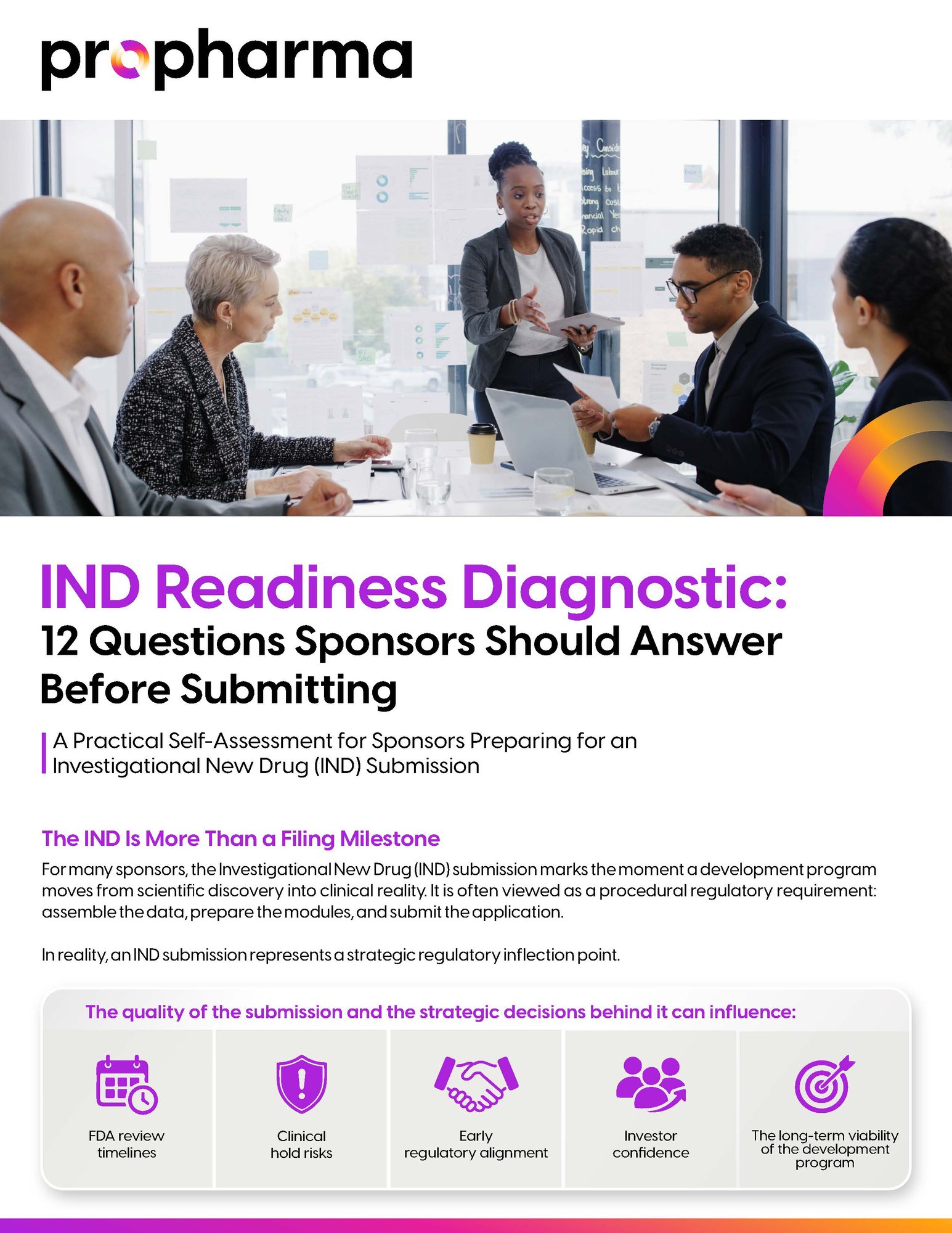
IND Readiness Diagnostic: Don’t Let Gaps Delay Your IND
Identify gaps early. Reduce FDA risk. Strengthen your submission strategy.
This practical assessment tool helps sponsors evaluate their readiness across five critical areas:
- Regulatory strategy
- Nonclinical support
- CMC readiness
- Clinical study design
- Submission quality and operational preparedness
In just a few minutes, sponsors can:
- Identify potential risks before submission
- Benchmark their readiness across key domains
- Prioritize areas for improvement
Why Does Early Assessment Matter?
Addressing gaps before submission is significantly more efficient than responding to FDA questions during review.
An early readiness assessment can help:
- Reduce the risk of clinical holds
- Improve the quality and clarity of your submission
- Enable faster and more productive FDA interactions
- Strengthen confidence among internal and external stakeholders
In a competitive development environment, these advantages can translate into meaningful time and cost savings.
How Does ProPharma Help Sponsors Achieve IND Readiness?
Our team of expert regulatory consultants partners with sponsors to ensure that IND submissions are not only complete, but also strategically positioned for success.
Our approach includes:
- Regulatory Strategy Alignment: Ensuring your development pathway aligns with FDA expectations and long-term goals
- Cross-Functional Gap Assessments: Identifying risks across nonclinical, clinical, and CMC domains
- Submission Optimization: Structuring INDs to support efficient FDA review
- FDA Meeting & Interaction Support: Preparing teams to respond effectively during the review process
With deep experience across therapeutic areas and product types, our team helps sponsors navigate the complexities of IND readiness with confidence.
TAGS: Food & Drug Administration (FDA) Investigational New Drug (IND) FDA Submission Regulatory Sciences