
AI in GxP: Recurring Compliance Gaps

August 17, 2026

Digital interface showing AI, legal, and cloud technology icons over a tablet and laptop workspace.
What challenges are we seeing as life sciences organizations expand AI adoption?

Artificial intelligence (AI) is increasingly embedded in compliance areas like medical information, pharmacovigilance, clinical operations, manufacturing, quality systems, and other regulated processes.

We are finding, however, that in many organizations, adoption has moved faster than the quality framework needed to govern it.

The most common concern is not the AI technology itself. It is the absence of clearly defined ownership, intended use, validation, human oversight, data controls, and lifecycle monitoring.

What’s Happening & Where to look

What Organizations are experiencing

What to look for

1. AI operating outside the quality system 

Business teams introduce chatbots, copilots, analytics tools or embedded vendor AI features without notifying Quality, Regulatory, IT or Privacy.

Is there a complete AI inventory? Does every use case have an owner, an intended use, and a GxP classification? 


2. Uncontrolled medical or patient-facing responses 

A chatbot generates unscripted medical responses, answers product questions or provides recommendations that should be reviewed or delivered by qualified healthcare or medical information personnel. 

Are responses restricted to approved content? Are escalation rules, disclaimers, medical review and human intervention clearly defined?

3. Patient safety information entering a "black box"

A chatbot, patient support tool or digital channel receives adverse-event or product-complaint information, but the information is not reliably identified, retained, escalated or sent to Pharmacovigilance and Quality. 

Have all digital intake channels been mapped to PV and complaint processes? Are detection, routing, reconciliation and reporting timelines tested? 

4. Intended use is not clearly bounded 

A tool introduced for administrative support gradually begins to summarize clinical data, recommend quality decisions, classify deviations, or influence product-release activities. 

Is the approved context of use documented? Are prohibited uses and decision boundaries defined? 

5. AI is not appropriately validated 

Validation is limited to confirming that the application opens and produces an output. Hallucinations, inconsistent responses, edge cases, prompt sensitivity, and failure conditions are not challenged. 

Does testing address the intended use, patient or product risk, accuracy, repeatability, false positives, false negatives and foreseeable misuse? 

6. Training and reference data cannot be traced 

The organization cannot explain which data was used to train or configure the model, whether the data were representative, or whether confidential or regulated information was used appropriately. 

Are data provenance, lineage, quality, representativeness, bias and usage rights documented? 

7. Human oversight exists only on paper 

A person technically approves the AI output but lacks the expertise, source information, time or authority needed to identify an incorrect recommendation. 

Is the reviewer qualified? Can the reviewer independently challenge the output? Are escalation and override decisions documented? 

8. Model and prompt changes bypass change control 

Vendors update the underlying model, retrieval sources, system prompts or functionality without formal impact assessment or regression testing. 

Are model versions, prompts, configurations and connected data sources under control? What triggers revalidation? 

9. No ongoing performance monitoring 

Performance is evaluated before launch but not monitored after deployment. Model drift, changing data patterns and degradation go undetected. 

Are performance thresholds, monitoring frequency, sampling plans, alerts and suspension criteria established? EMA specifically recommends monitoring to identify model drift and degradation. 

10. Inadequate records and audit trails 

The organization cannot reconstruct what information was entered, which model or prompt version was used, what the AI produced or how the final decision was made. 

Are inputs, outputs, user actions, timestamps, versions, approvals and overrides retained in an attributable and reviewable form? 

11. Weak supplier oversight

Organizations rely on a vendor’s general security certification or marketing claims without assessing the specific GxP use, model controls, subcontractors or update practices. 

Does the supplier assessment cover validation support, model transparency, data handling, incident notification, change notification and right-to-audit provisions? 

12. Privacy and cybersecurity risks are assessed too late 

Employees enter confidential, personal, clinical or proprietary information into public or externally hosted AI tools. Prompt injection, unauthorized access and data leakage are not considered. 

Are approved tools, permitted data types, data residency, retention, access controls and cyberattack scenarios defined? 

Questions to ask about AI-enabled systems:

  • Can the tool recognize potential adverse events and product complaints?
  • Is the original patient or reporter language retained?
  • Is information routed promptly to the appropriate safety or quality function?
  • Are duplicate detection, follow-up, and reconciliation controls established?
  • Has the end-to-end process been tested—not merely the chatbot interface?
  • Can the organization demonstrate that no safety information was lost?

Can Your Organization Answer These Questions?

  1. Where is AI currently being used?
  2. Who owns each AI use case?
  3. What decision or regulated process does it influence?
  4. What could happen if the output is incorrect, incomplete, or delayed?
  5. What data does the tool receive, retrieve, generate, and retain?
  6. How was the system validated for its specific intended use?
  7. Where is qualified human review required?
  8. How are model, prompt, and configuration changes controlled?
  9. How will performance degradation or model drift be detected?
  10. Can each AI-assisted decision be reconstructed during an inspection?

An inability to answer these questions is itself an AI governance finding.

What an AI Compliance Assessment Should Examine

  • Governance and accountability: AI policy, inventory, ownership, approval pathways, roles, training and AI literacy.
  • GxP use-case risk: Intended use, context of use, patient impact, product-quality impact and regulatory significance.
  • Validation and model credibility: Requirements, testing strategy, data suitability, performance metrics, limitations and acceptance criteria.
  • Data integrity and traceability: Data provenance, ALCOA+ controls, audit trails, record retention and reproducibility.
  • Human oversight: Reviewer qualifications, decision authority, escalation, overrides and automation bias.
  • Patient safety and quality interfaces: Adverse-event intake, product complaints, medical information, signal detection and regulatory reporting.
  • Supplier and technology oversight: Vendor qualification, contractual controls, cloud hosting, model changes, subcontractors and third-party data.
  • Lifecycle controls: Change management, periodic review, drift monitoring, incident management, CAPA and decommissioning.

AI readiness is not a one-time validation exercise

Effective AI oversight requires a lifecycle approach that connects Quality, Regulatory, Pharmacovigilance, Medical, Clinical, IT, Data Science, Privacy and Cybersecurity.

Organizations do not need to eliminate AI risk. They need to demonstrate that the risks are understood, controlled, monitored, and appropriately escalated.

How ProPharma Supports Compliant AI Adoption

ProPharma’s QA/AI & ML Compliance Services’ Quality, CSV, and Data Integrity experts help organizations implement AI in a way that is both innovative and inspection ready.

Our capabilities include:

  • Development of risk-based AI governance frameworks
  • AI system selection and suitability assessments for GxP use
  • Qualification and validation aligned with regulatory expectations
  • Design and implementation of monitoring and lifecycle management programs
  • Establishment of governance, change control, and oversight SOPs

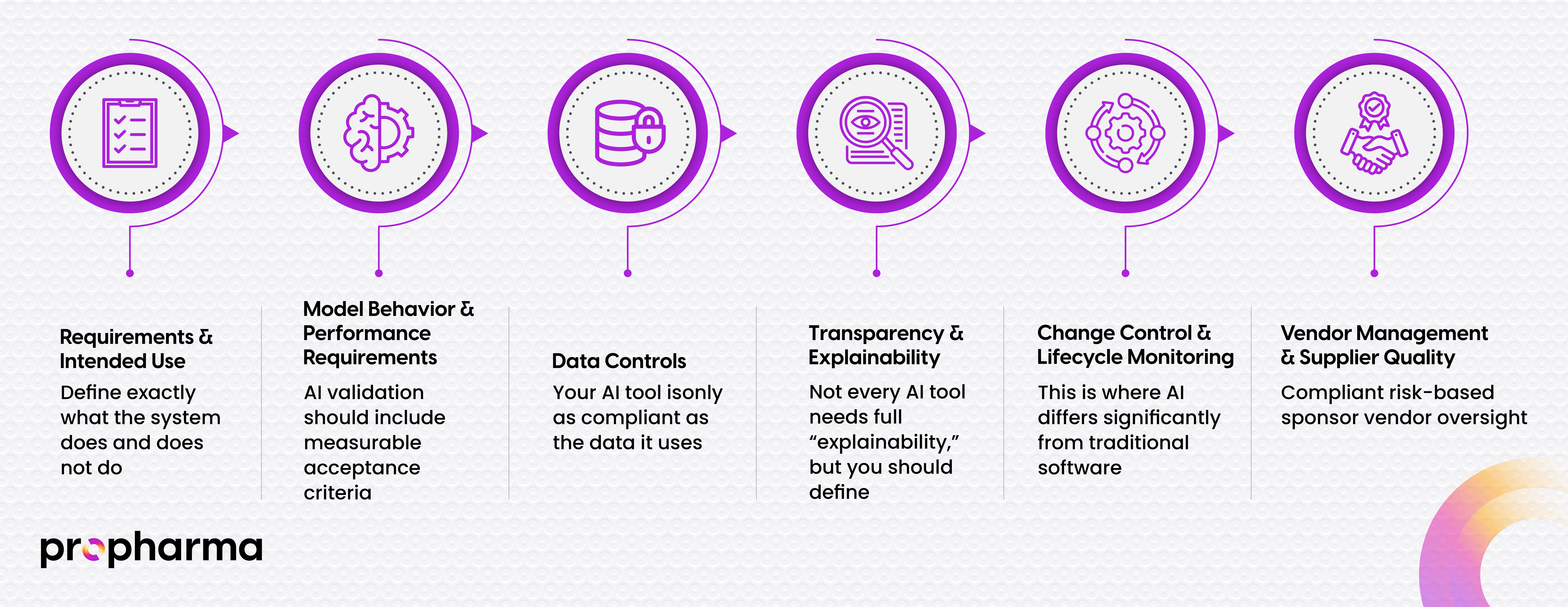
Whether you’re building internally or selecting a vendor solution, here are the core controls QA teams should evaluate and embed early:
Author

James Meckstroth

James Meckstroth

Vice President, Compliance & Quality Assurance


TAGS: